One day I noticed how many thoughts in my head started with “I have to…”.
- I have to reply to that message.
- I have to organise school forms.
- I have to keep on top of work.
- I have to exercise.
- I have to clean the kitchen.
- I have to be patient.
- I have to remember that birthday present.
- I have to volunteer.
- I have to make healthy lunches.
- I have to stay on top of everything.
It felt endless.
And what struck me was not only the volume of responsibilities, but the feeling underneath them.
Pressure.
Looking back, I think this is one of the reasons so many working mothers are overwhelmed.
Like life had become one long list of obligations I was trying not to fall behind on.
Many working mothers live in this space for extended periods – overwhelmed by all the things that feel equally important and urgent.
It’s not that they are doing life badly. This happens because modern motherhood involves carrying an enormous amount of invisible responsibility while also trying to function well at work, maintain relationships, care for children, manage a household, stay emotionally regulated and somehow still look after yourself too.
Over time, everything can start feeling equally important.
That’s when many women stop asking “What actually matters here?”, and start living inside a constant stream of “I should,” “I need to,” and “I have to.”
Why working mothers feel overwhelmed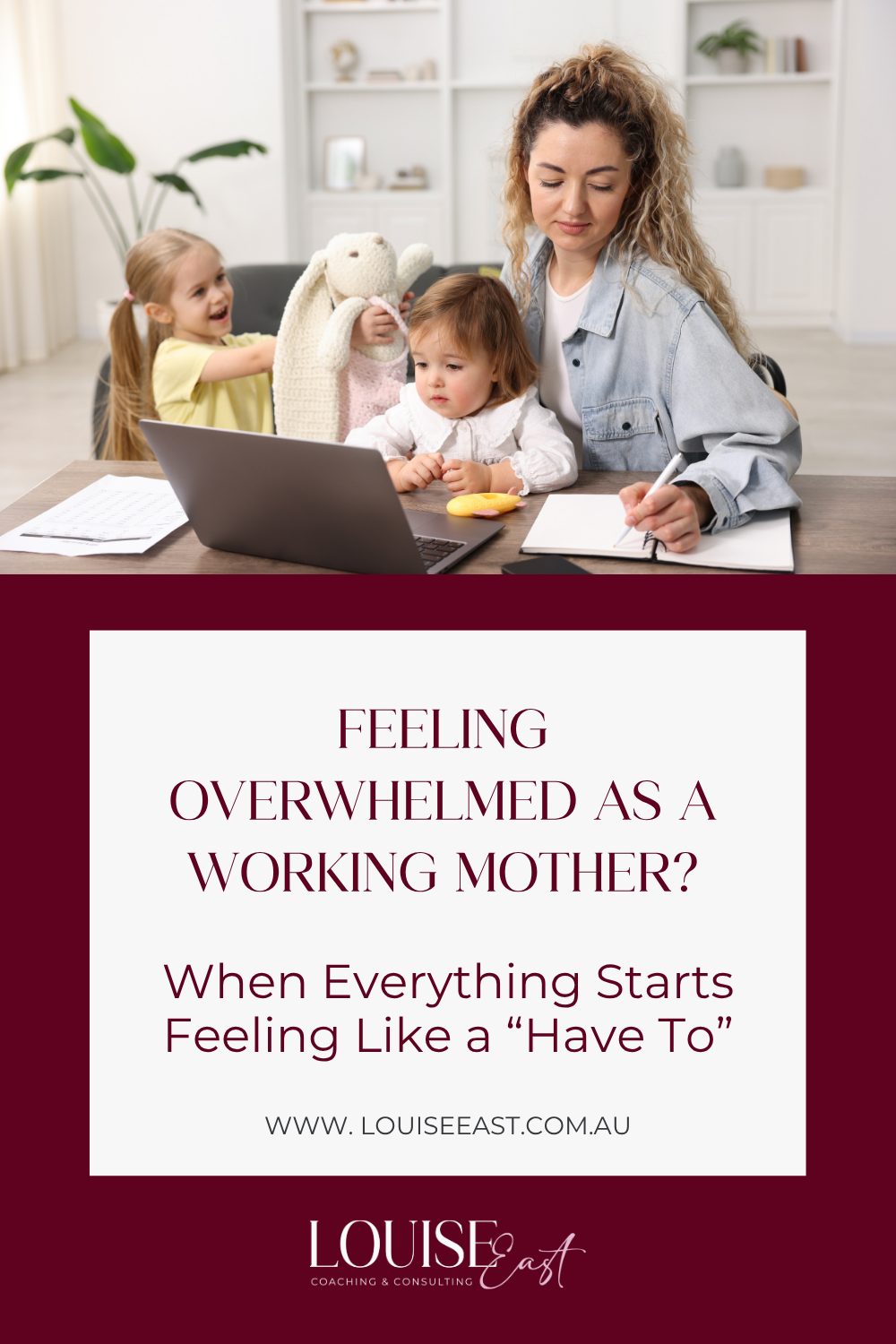
This isn’t just a time management issue. There’s usually a deeper emotional layer underneath.
Many women were socialised from a young age to be responsible, capable, helpful and considerate of other people’s needs. Then motherhood amplifies that.
Suddenly, there are endless things that genuinely do matter: your child’s wellbeing, emotional safety, school life, health, routines, relationships, and development.
At the same time, many mothers are also carrying workplace expectations built around constant availability, performance and productivity.
Then add social expectations on top:
- Be present
- Be organised
- Make memories
- Keep the house pristine
- Stay healthy
- Look good
- Nurture relationships
- Don’t lose yourself
- Enjoy every moment
- Contribute at school
- Be emotionally regulated
- Don’t forget self-care.
It’s a lot.
And when women are already carrying high levels of mental and emotional load, the brain often stops differentiating between:
- True priorities
- Genuine responsibilities
- Internalised expectations
- Preferences and desires
- Perfectionism, and
- Social or cultural pressure.
Everything starts feeling like a “have to.”
That creates constant internal pressure.
The hidden role of identity
For many overwhelmed working mothers, identity also plays a huge role in driving the pressure. Especially for women who grew up being praised for being capable, mature, independent, high-achieving, or the “good girl”.
They have unconsciously built identities around being the one who handles things well. And when life becomes genuinely overwhelming, they still feel pressure to keep coping, achieving and making sure everyone is happy. Their nervous systems have learned that being responsible and competent is tied to worth, safety or belonging. That’s why even relaxing can feel uncomfortable for some women. Or asking for help can feel strangely vulnerable. Or letting something be “good enough” can trigger guilt.
This is also one of the reasons matrescence can feel so confronting. Motherhood often exposes the invisible rules we’ve been living by for years.
Rules like:
- I should be able to do it all
- I shouldn’t need too much
- Everyone else’s needs come first
- Rest has to be earned
- Being a good mother means giving constantly.
Eventually, many women hit a point where those rules stop feeling sustainable.
The problem with living inside too many “shoulds”
When everything becomes a “have to,” life can start feeling heavy even when some of the things genuinely matter to you. There’s a big difference between “I want to do this” and “I feel pressured to do this.” One feels connected to values or desires. The other feels driven by obligation, guilt or fear.
This is why many women feel disconnected from themselves during certain seasons of motherhood. There’s so much focus on managing responsibilities that they slowly lose touch with what:
- They enjoy
- They need
- Actually matters most to them
- They have capacity for in this season.
In fact, there’s often very little spaciousness left even to ask those questions.
Even inside responsibilities, there is still room for choice
It’s also important to say this: recognising pressure and unrealistic expectations does not mean pretending working mothers have no real responsibilities.
Women genuinely do have a lot they need to carry in this season of life – work, parenting, financial responsibilities, caring responsibilities, emotional labour, the mental load. Some things really are “have to’s.”
But where women sometimes lose themselves is when they stop noticing that even inside necessary responsibilities, there can still be room for choice, values, grace, creativity or self-compassion.
You may have to feed your children at dinner time. But perhaps there are different ways to do it depending on your capacity: simple meals, shared responsibility, takeaway on some nights, lowering standards, sitting together instead of making things perfect.
You may have to work. But there may still be questions around boundaries, flexibility, meaning, ambition or sustainability.
You may have to care for others. But perhaps not at the cost of abandoning yourself completely.
This matters because when women feel trapped inside obligation with no agency at all, resentment, exhaustion and hopelessness can start building quickly.
The goal is not removing every responsibility. It’s reconnecting with some sense of choice and self inside the life you are already living.
The “Have to”, “Should” and “Want to” Check In
So, given our responsibilities are real, it helps to become more intentional about what category things actually belong in.
One exercise I often use with clients is to sort the things they are carrying into three categories:
Have To – The genuine non-negotiables in this season.
Want To – Things connected to values, meaning, joy or genuine desire.
Should – The expectations, pressure, guilt or perfectionism that may not actually be essential.
This can be surprisingly revealing.
Many women realise they have been carrying “shoulds” as though they were survival-level responsibilities – have to’s.
Realising this can reduce some of the unnecessary emotional pressure surrounding it.
Of course, many responsibilities don’t fit neatly into one category. Some things genuinely are important and necessary while also carrying layers of guilt, perfectionism or social pressure around how they “should” be done.
For example:
- Have to: Feed my children.
- Should: Make healthy meals from scratch every night.
- Want to: Enjoy connection around the table.
Or:
- Have to: Earn money to support my family.
- Should: Work harder than everyone else in the team to prove myself.
- Want to: Do work that feels meaningful and allows me to still spend time with my family.
The exhaustion isn’t only coming from the responsibility itself, but also the invisible pressure of the “should” and potentially guilt, or resentment if the “want to” is not a reality.
When we know what really is a “have to”, what we genuinely want, and where the extra pressure is coming from, we can make more intentional decisions about where to place our time, energy and emotional resources, instead of treating everything as equally urgent and important.
You are allowed to reassess the pressure
If you’ve been feeling overwhelmed as a working mother, it may be worth asking whether the pressure has slowly become normalised.
We aren’t meant to live in a constant state of emotional and mental overload. Nor are mothers failing because they cannot endlessly absorb unrealistic expectations without impact.
Sometimes the most important thing is simply pausing long enough to ask:
- What actually matters here?
- What have I turned into a “have to” that might not need to be?
- What pressure am I carrying that no longer fits the life I want to build?
- What do I actually want?
Those questions aren’t selfish. They are an essential way for overwhelmed working mothers to create a more sustainable way to live.



0 Comments