You’re functioning. You’re competent. You might even be succeeding by the measures that matter to your organisation. And yet there’s a low-level tension running underneath it all.
You find yourself scanning job ads late at night. Imagining a different kind of work. Wondering what it would feel like to use your skills in another context. Or do something completely different. Then almost immediately, you talk yourself out of it.
You tell yourself you’ve worked too hard to get here. That you should be grateful. That this is probably just a phase.
So you stay where you are, but then 6 months later, after a challenging day, you find yourself wondering all the same things again. And again, a few months after that.
Why overthinking feels safer than deciding
Not taking action in this situation is understandable. The stakes feel really high. You don’t want to make the wrong decision.
You might worry that leaving would mean wasting years of study and experience. You might fear losing income or status. You might not want to dismantle an identity you’ve carried for a long time. Even if that identity feels tight now, it’s still familiar.
Overthinking becomes a holding pattern. As long as you’re analysing the situation, you don’t have to risk anything. You can rehearse possible futures without committing to one.
The problem is that analysis has diminishing returns. After a certain point, more thinking doesn’t create clarity. It just deepens the spiral.
Underneath the mental loops, there’s usually something simpler: fear of regret, fear of loss, or fear of being wrong.
Naming that can help you get past it.
You haven’t wasted everything you know
One of the strongest stories that keeps women stuck is the idea that changing direction invalidates what came before.
If I move on from this role, what was the point of the last ten years?
That question assumes that experience only has value if it stays in the same lane.
Skills don’t disappear because the setting changes. For example, communication, decision-making, strategic thinking, conflict resolution, influencing and relationship building – these travel with you and deepen over time. They rarely belong to just one job title.
Changing roles does not erase your history. It reframes it.
There’s a difference between abandoning something and building on it. Most career shifts fall into the second category, even if they look dramatic from the outside.
Matrescence changes the lens
For many women, this restlessness in their career intensifies after becoming a mother.
Matrescence reshapes how you see yourself, the world and your place in it. It alters your sense of time and capacity. It often sharpens your awareness of what feels aligned and what doesn’t.
Work that once felt energising might now feel draining. The trade-offs you once accepted might start to feel heavier. That doesn’t mean you’ve become less ambitious. It often means your ambition is being redefined and redirected.
It can be unsettling to realise that the version of success you once chased no longer fits the life you’re building now. There can be grief in that. And there can also be relief.
The key is not dismissing the shift as a temporary wobble, especially if you keep landing back in the same place of wondering. It deserves to be taken seriously enough to explore.
Questions that create movement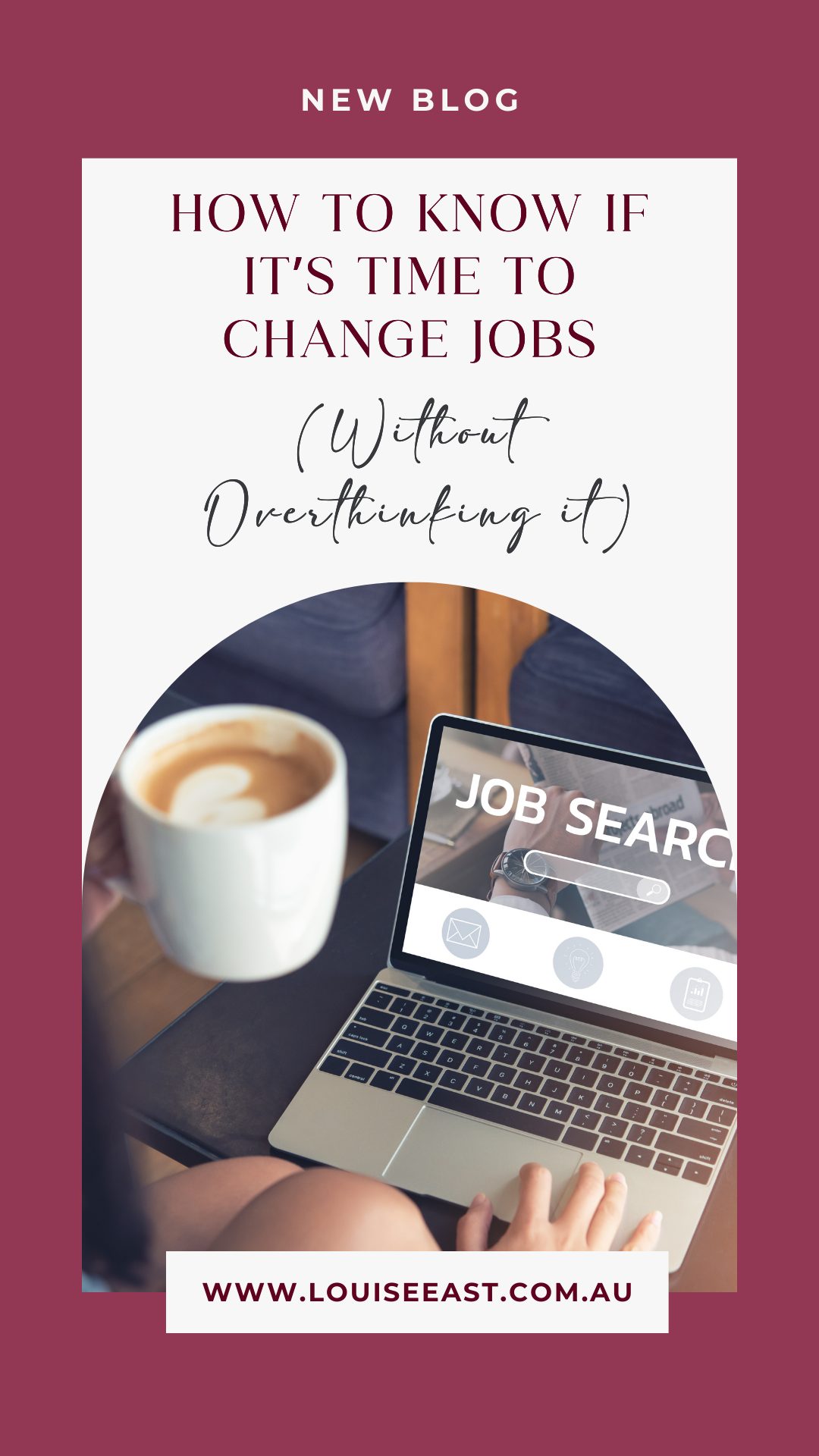
You don’t need to decide whether to resign tomorrow. But you do need better questions than “Should I quit?”
Start with what feels consistently heavy. Not what annoys you occasionally, but what drains you repeatedly. Is it the pace? The culture? The lack of autonomy? The misalignment with your values?
Then look at what still gives you energy. Even in roles that don’t fully fit, there are usually parts that feel alive. Notice those patterns.
It can also help to imagine that nothing changes. Picture yourself in the same role, with the same conditions, two years from now. What happens in your body when you think about that? Sometimes your response there is more honest than any spreadsheet of pros and cons.
Another useful question is what you’re actually afraid of losing. Be specific. Is it financial security? Professional credibility? A sense of competence? Once you can see the trade-off clearly, it becomes easier to weigh it realistically rather than catastrophically.
There’s also a quieter question beneath all of this: what are you afraid you might discover if you let yourself get really honest? Sometimes we avoid clarity because it would confirm what we already suspect.
Take your time with these questions. Sometimes the answers take a little time to emerge.
Change doesn’t have to be dramatic
Part of what keeps people stuck is the belief that a career change has to be a stark change. Handing in notice. Starting from scratch. Announcing a complete reinvention.
Most transitions are far less dramatic.
They begin with small steps – reaching out to someone in a different field, updating a resume to see how your skills look on paper now, or exploring internal moves before external ones.
You can gather information without committing. You can test ideas before acting on them. You can take small steps that build data rather than relying on imagination alone.
Clarity grows when you move, even slightly.
You are allowed to evolve
If you’re in this space of questioning, it can feel like everyone else has a clear path and you’re the only one hesitating.
In reality, many people stay in roles that no longer fit because it feels safer than change. Reflecting on your direction does not make you flaky. You’re trying to make an intentional, aligned change. Reflection is needed.
You are allowed to reassess your work as your life changes. You are allowed to want alignment, not just achievement. You are allowed to outgrow something that once made sense.
Start with telling yourself the truth about what you’re experiencing.
Instead of asking, “What should I do?” try asking, “What is this restlessness trying to show me?”
You don’t need a 5 year plan right now. Just be willing to explore and allow yourself to evolve.




0 Comments